CORC Forum 2025: highlights and reflections
We were delighted to see so many of you at our recent 2025 CORC Forum. The attendance and engagement is an encouraging reflection of the value colleagues place on using real-world evidence to improve the support we offer children and young people with their mental health and wellbeing .
This blog shares reflections from our team, and those who kindly shared their feedback after the event. If you do have further reflections or questions, or would like to see something particular feature next year, please do contact us at CORC@annafreud.org.
A huge appreciation and thank you to all our great speakers – to receive comments such as “brilliant” and “exceptionally informative and enjoyable” is testament to the quality of their content and delivery. The range of different speakers and topics resonated with all.
“Hearing from researchers, practitioners, different services and the CORC team, the information was applied to practice and therefore felt very relevant to our service”.
So, despite the reality behind the scenes within our Anna Freud offices having to factor in a fire alarm during the event and evacuate the building (luckily only a test), we are pleased it didn’t disrupt the experience!
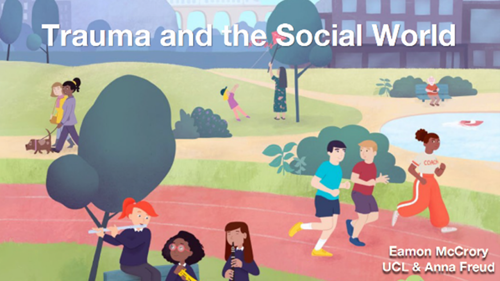
The opening presentation from Anna Freud’s CEO Professor Eamon McCrory was powerful and inspiring, discussing the early impact on risk and resilience on children and young people who experience trauma, and how the impact of their trauma has an impact on their social world; influencing the construction of their social world, which then continues to impact their mental health over time.
Eamon highlighted that social thinning in recent years mean that "opportunities for young people to interact, enabling them to build positive relationships is a primary focus for resilience and prevention". Our Research Officer, Anoushka Kapoor was encouraged to reflect that a number of evaluations CORC have recently been involved in explore trauma-informed approaches, and will be helpful and applicable in this area: we also know that many of your services aim to do this, and we enjoy working with you to demonstrate the impact it can have.
Kate Dalzell provided an overview of CORC’s work over the past year, highlighting the consistent and increasing focus on measuring outcomes across a widening range of services, social support systems and agencies.
Over recent years CORC has learned a great deal about how to meaningfully measure mental wellbeing outcomes for different people and in different contexts: tailoring and honing approaches, and considering the differing needs of diverse groups of young people is important. At the same time we need to emphasise some of the core principles of good practice that get raised by young people time and time again, to carry that learning into new services and settings - and act on it.
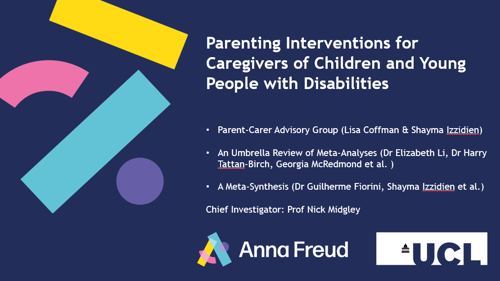
Elizabeth Li and Lisa Coffman next took attendees through research exploring parenting interventions for parent carers of disabled children and young people and those with special educational needs. The research was shaped by a parents through the work of a parent carer advisory group, building on the Lundy model. The clear message from the Parent-Carer Advisory Group was that: “involving parents isn’t just beneficial, it’s essential. When we bring the voices of those who parent a disabled child into research not as participants, but as partners, the work becomes richer, more ethical and ultimately more impactful.”
You can find useful information here for those parenting disabled children and young people: Foundations website; Anna Freud website
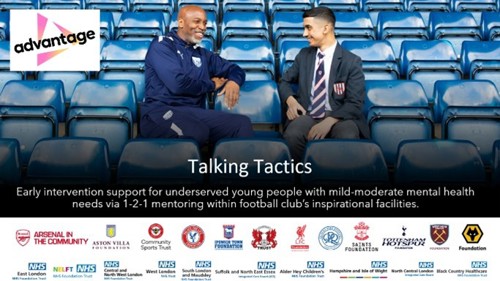
Two different CORC members, Advantage Mentoring and Jami, presented their work on measuring outcome. CORC Regional Improvement Officer Rachael Grant appreciated the opportunity to hear “the benefits of routine data collection and analysis, alongside some of the challenges and how they are overcoming them”.
Konrad Deckers Dowber, Managing Director at Advantage, spoke about Talking Tactics, a community interest mentoring programme for 11 to 21 year olds which partners the NHS with football clubs. Advantage have been a CORC member for many years, and their work in evidencing impact informed a shift in their model to support those with special educational needs. Konrad said it’s “really important to evidence impact. By taking measurements and conducting research to see if its working, it informs us how to scale our mission and focus on quality of what we provide and have confidence when applying for contracts and funding”.
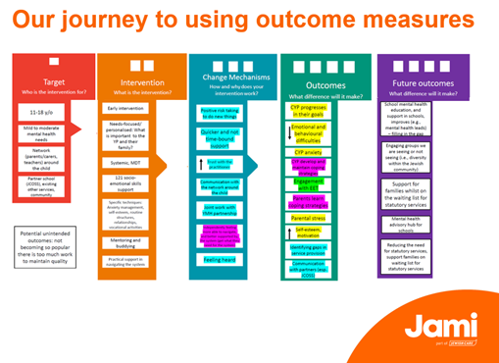
Mya Goschalk and colleagues from Jami (part of Jewish Care) described their work with CORC to create a logic model, and their journey in using different outcome measures. Mya spoke of the value of being able to “bring back the research and impact data to our staff team to inform best practice going forward and be more relevant to our children and young people.”
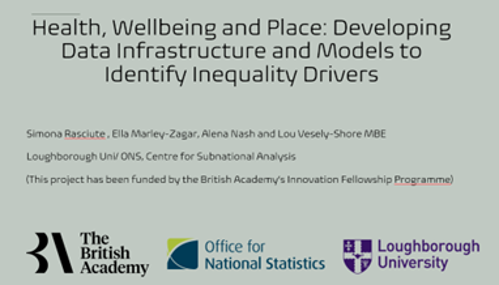
The talk by Dr Simona Rasciute and colleagues from Loughborough University described their work to develop a data infrastructure and analytic models able to explore data from various sources to better understand predictors and causes of chid mental ill-health. In this endeavour they have linked data from DfE, NHS and ONS datasets - including information about health, education, socio-demographic, residential and contextual factors.
To-date the research has explored factors such as parents’ mental health and absences from school. In one key finding, the data has shown that child absences from school increase the probability of having mental health issues, and that conversely, mental health issues impact child absences from school. The data shows that where children having SEN support from school, this improves absence rates.
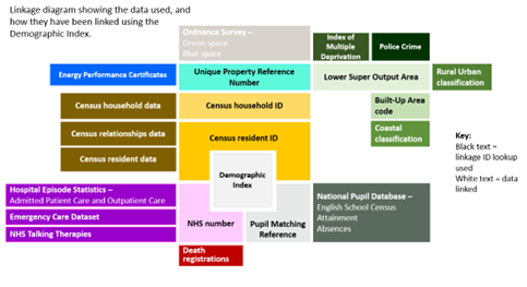
Our Research Officer Arthur Pander Maat – whose work in CORC involves routinely analysing data to understanding how mental health outcomes vary between different groups of young people – appreciated the herculean effort involved, the subtleties of this work, and its value: “an example of the kind of high-powered research that we'll need in order to truly advance our understanding of the drivers of mental ill-health".
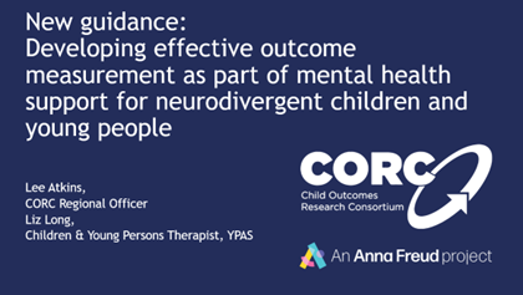
In the last session of the day, Lee Atkins, CORC Regional Improvement Officer, and Liz Long, a children and young people’s therapist at YPAS, talked attendees through new guidance for Using outcome measures effectively with neurodivergent children and young people. Liz, part of the working group that informed this guidance, is herself autistic, and she shared the challenges she experiences in her practice and the time it takes to go through measures and make them meaningful for neurodivergent children and young people - so they can experience the benefits, and so their outcomes are captured in the evidence and research base.
A number of attendees found this session helpful as an opportunity to hear about how “neurodivergent children and young people may be understanding some of the routine outcome measures used within services”, and said it is prompting them to review the outcome measures they are using, and to think more relationally about how they are using them.
The free to download guidance is now available on the CORC website here.
Head of CORC, Kate Dalzell said she hugely appreciated the quality and thoughtfulness of the research and projects presented at the CORC Forum this year. “The spread of speakers together reflected the richness of work that is taking place to understand and improve the way we support children and young people with their mental health. It was valuable to hear from contributors with a range of perspectives - academics, parents, managers and practitioners - and to hear about the contribution of insight from large data-sets and formal research, alongside insight about more targeted and tailored approaches to supporting particular groups of children and young people in different contexts and settings”.
For all CORC members, recordings from the event will be posted in the members area of the CORC website soon - we'll let you know once they're there.