Wellbeing Measurement for Schools case study by Mental Health Support Team in Liverpool
We were recently delighted to read this article featured in ‘The Psychologist’ by The British Psychological Society, authored by Education Mental Health Practitioner John Olusola Ojo (EMHP) based at Alder Hey Children's NHS Foundation Trust, Liverpool Mental Health Support Team (MHST). It’s a really interesting piece.
It is also a very nice example of our Wellbeing Measurement for Schools resources being used to provide insight to inform useful interventions. The Wellbeing Measurement for Schools (WMfS) modular pupil surveys, developed by Child Outcomes Research Consortium (CORC) and the Evidence Based Practice Unit within Anna Freud, are free for all education settings to use.
John said he enjoyed being part of this study, which aimed to understand what goes through the minds of pupils, especially boys, regarding help-seeking behaviours. It also explored using the CRADLE framework to help them express and validate their feelings while improving safeguarding for all young people.
We spoke to John about their particular activity to find out more:

Why was this audit conducted?
The survey wanted to look beyond a general sense of happiness within a group of 70 Key Stage 2 (KS2) pupils in a partner primary school in Liverpool, and probe into specific domains like relationships, emotional strengths, and the help and support domain - to capture who pupils turn to when the internal pressure rises. It was a review of their internal world and their coping strategies. This survey received a significant contribution from Claire Spicer.
Mental health shouldn’t be a 30-minute lesson on a Friday afternoon, but be integrated into the very atmosphere and culture of the school. At Alder Hey we see that most successful interventions are those that adopt this holistic view, normalise the struggle and reduce the friction of help-seeking.
Why were the WMfS survey(s) decided to be used?
Wellbeing Measurement for Schools (WMfS) was chosen because it provides an evidence-based measure to identify both the strengths and the challenges regarding pupil wellbeing. This decision aligns with IAPT principles for evidence-based practice and decision-making for young people. It offers specific validated surveys to measures specific coping skills. It’s a free to use modular survey, offering a variety of important topics for pupils.
Which surveys did you use?
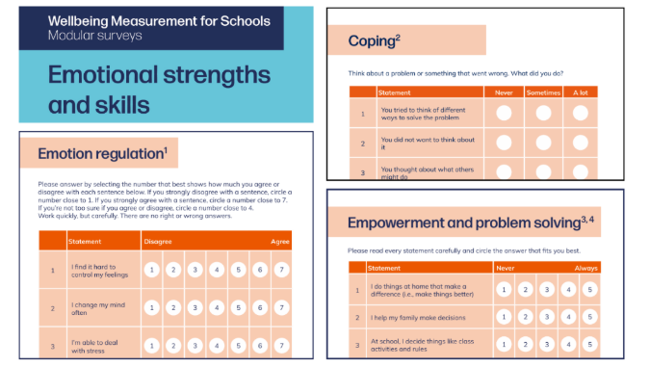
For the particular focus of our cohort, we selected the coping subscale of the Emotional strengths and skills modular survey. This specific subscale measures three distinct areas:
• Problem-focused coping
• Emotion-focused coping
• Seeking social support
How did you go about using these?
The audit was scheduled via email coordination with the school's Designated Mental Health Lead and Safeguarding Lead. Before completing the survey, students attended a short workshop focused on mental wellbeing and coping strategies. The questionnaires were then administered digitally on school iPads using QR codes.
Data collection and subsequent analysis were completed by August 2025. Free guidance is provided by CORC for best managing this.
Pupils were communicated with using straightforward and clear language. They were given the option to opt out to ensure their participation was voluntary.
Information was anonymised and stored securely on the Trust OneDrive, ensuring that only authorised staff had access to the data.
Beneficial Aspects: The digital approach via QR codes allowed for efficient collection. A key learning was that using such data-driven strategies helps identify the most effective teaching methods for young people and allows for the modification of future interventions.
What outcomes did this produce, for learning, awareness and interventions?
The survey revealed several key insights that have informed next steps:
Coping Preferences: Most students rely on problem-focused coping (average score 5.5/8) but have very low scores for social-support coping (1.7/4).
Gender Gaps: A significant gap was identified, with female students being much more likely to seek social support than males. This was the angle for The Psychologist article.
Interventions: As a result, targeted interventions are considered to destigmatise help-seeking behaviour, particularly for at-risk male students.
Staff Training: There is a recognised need for staff to teach healthier emotional regulation methods to move students away from avoidance-based coping.
Do you have any future plans having conducted this?
We aim to integrate emotional literacy into the physical education curriculum, so that boys in particular start to see that mental resilience is a skill to be trained, just like a football drill. If a coach discusses the mental impact of a lost game, it validates the boy's internal experience in a language he already understands and respects.
I’m planning to conduct a survey to evaluate the emotional wellbeing of school staff and how it affects pupils - using the Wellbeing Measurement for Schools (WMfS) Staff Survey. I am currently in the process of obtaining further data from the school, and NHS Trust approval before conducting this.
We believe this is necessary because research demonstrates that staff wellbeing is intrinsically linked to student outcomes (Dreer, 2023). Ref: Dreer B (2023) On the outcomes of teacher wellbeing: a systematic review of research. Front. Psychol. 14:1205179. doi: 10.3389/fpsyg.2023.1205179.
If you have any thoughts or questions about this blog, or our Wellbeing Measurement for Schools programme – please get in touch.
Wellbeing Measurement for Schools
To note: Since first offering the Wellbeing measurement for schools (WMfS) staff survey to schools in 2019 we have managed to maintain our original pricing. Due to rising costs the price to schools will increase by 10% to £330 for primary schools and £440 for secondary schools from September 2026. We believe this still represents excellent value for money.
We are however able to offer an 'early bird' price for surveys in the 2026-27 academic year.
If you book your survey and pay your invoice before the 31 August 2026 you will pay the current price. You can book your survey to take place any time between September 2026 and July 2027, as long as payment is made before the end of August, you'll only pay £300 for a primary school survey or £400 for a secondary school survey.