A New Tool to Support Shared Decision-Making with Young Clients: Understanding Preferences in Counselling (U-PIC)
The University of Roehampton have been working with Anna Freud colleagues over the personalisation and empowerment for young people around mental health issues, and they have developed a new measure to help young people have more say in their choices over psychological interventions.
Mick Cooper, Professor of Counselling Psychology, University of Roehampton provides the following information:
What style of therapy do your young clients want?
Do they want something more directive or more client-led, for instance, or a greater focus on their emotions or a more cognitive orientation?
Why young people’s therapy preferences should be heard
We all know that clients, both young and old, can differ in their preferences for therapy, and research shows that clients (a) tend to do better when their preferences are matched, (b) stick at therapy for longer, and (c) have better therapeutic relationships (see, for instance, here). Granted, this research is mostly with adults, but the ethical responsibility to listen to what patients want and accommodate, where possible and clinically indicated, runs across all age groups. This isn’t about always doing whatever young clients and/or their families say they want (and, of course, these can be different things), and it’s also not about assuming that clients will always know what they need. Rather, it’s about opening up a space for shared decision-making where clients, if they want to, can feel that treatment is something they’re involved in making happen, rather than something done to them.
A new tool to support preference-based care
Now, our team based at the University of Roehampton (along with colleagues from the US, China, and the Czech Republic) have developed a tool that can help young clients articulate the style of treatment that they want. Our Understanding Preferences in Counselling (U-PIC) form was developed with funding from the British Association of Counselling and Psychotherapy, and in association with young people and professionals at the McPin Foundation: a mental health research charity that works to ensure that young people are involved in research about them.
What does it measure?
The U-PIC form invites young clients to indicate the style of intervention they would like across four dimensions:
1. whether they want to use creative materials (like art) or mainly focus on talking
2. whether they want more or less therapist direction
3. whether they want more or less therapist challenge
4. the degree to which they want to go deeply into their emotions.
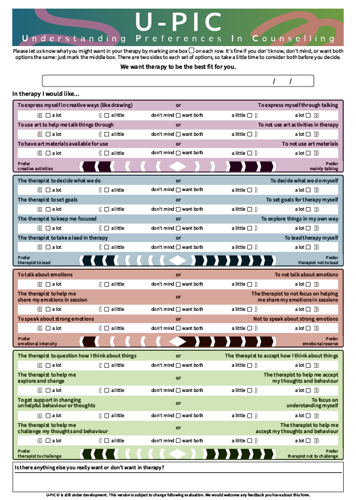
Young people can also indicate any other strong preferences they might have for therapy: for instance, not wanting long silences.
The form was developed through a robust, seven stage process (from youth and therapist consultations to confirmatory factor analysis and field testing), and has proven psychometrically robust as well as clinically acceptable. The U-PIC was designed to be relevant across all therapeutic treatments, from supportive counselling to CBT: it’s not about which therapeutic approach to use, but about how therapists can work within that approach to best effect.
More information and how to access the measure
More information about the U-PIC can be found at Young Person's Questionnaire - Talking Preferences , where the form can also be downloaded.
On the site, there is also a portal where young people can complete the form online (computer, tablet, or smartphone) and be given a read-out of their strong preferences. This can then help to inform the approach that the therapist takes: again, it’s not a mandate for what to do but the starting point for shared decision-making.
All our resources are freely available for download and use. As with our adult preference measure, the Cooper-Norcross Inventory of Preferences, we imagine that the form will evolve on the basis of feedback and research. We hope you and your clients will find it of value.
Please do let us know how you get on with using the U-PIC, and any comments/suggestions for improvement: mick.cooper@roehampton.ac.uk