New guidance on working with goals in youth mental health
We recently completed work on a project focused on developing practice principles for working with goals in youth mental health services, funded by a Canadian Institutes of Health Research and led by Lori Wozney at IWK Health.
The project started with a question that felt both simple and surprisingly unresolved: we often ask young people about goals in therapy, but are we actually doing it well?
“Done well, goal work can be one of the clearest ways we show young people that their voice matters, their context matters, and their hopes for change belong at the centre of care.”
In mental health services, goals work is commonplace internationally. It is demonstrated in assessments, care plans, reviews, and progress and outcome conversations. But in practice, it can easily become routine, rushed or shaped more by paperwork than by the young person’s voice. That was the starting point for our project.
By goals work, we mean the conversations, decisions and reviews centred on objectives through which young people, families, caregivers or support persons, and clinicians identify what change would be meaningful and how therapy might support it. We wanted to develop guidance to help clinicians make goal conversations more meaningful, more equitable, and more connected to formulation and treatment planning.
How we developed the guidance
We worked in stages: first, we looked closely at the literature to understand how goal-oriented work is described across child and youth mental health. This included two reviews: one focusing on mapping existing research on goals work across youth mental health and wellbeing settings, and a narrative review synthesising what evidence tells us about how goals work is understood and delivered in outpatient youth mental health and substance use services. You can read our published scoping review here.
A highlight of this work was speaking to young people, caregivers, and clinicians at the next stage of the project, about what goal work feels like in practice: what helps, what gets in the way, and what can make the process feel tokenistic or unhelpful. Finally, we took those ideas and brought together clinicians and researchers at a consensus meeting in Nova Scotia, Canada to refine learning into practical guidance. By working in stages, the final set of principles was shaped not just by theory, but by lived experience, clinical expertise and informed by real-world complexity.
What we learned along the way
What came through repeatedly was that good goals work is not just about writing down a target, but is about how the conversation is held. Young people told us that goals only feel useful when they connect with what matters in their lives, when there is space to find the right words, and when adults do not take over. Clinicians described the challenges of balancing collaboration with risk, family dynamics, service expectations and limited time. Out of that came seven complementary and integrated principles grouped as participant factors (who is involved in goals work and how), relationship factors (how goals are discussed and therapeutic relationships are built together), and intervention factors (features of strategies, approaches, and techniques used in practice). Together, these principles aim to make goal conversations more contextually aware, collaboratively empowering, and clinically grounded.
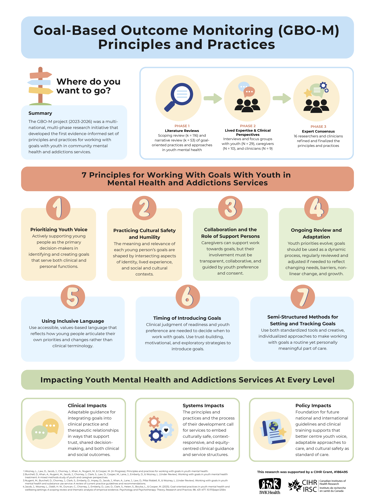
The principles in everyday clinical work
For us, the value of the principles is that they give clinicians a way to pause and ask better questions before, during, and after goal conversations – attending to the young person’s broader context beyond the goal itself. Their hopes, sense of possibility and willingness to share may be shaped by culture, family expectations, experiences of trauma, school, housing, poverty, discrimination, previous services, or the simple fact that adults have not always listened well. A goal that looks small on paper may be hugely significant in context; a goal that sounds unrealistic may be carrying an important story about identity, belonging, or hope.
The principles also ask us to keep checking whether the young person is genuinely leading the direction of travel. That does not mean clinicians step back completely. The clinical role matters: bringing formulation, knowledge of risk, evidence-informed practice, and the ability to think with young people about what might help are all part of what makes goals work therapeutic rather than administrative. But we also need to be alert to the subtle ways service pressures, professional confidence, or caregiver anxiety can take over. A useful prompt we returned to often was: whose goal is this, and who would recognise it as meaningful?
Finally, the principles connect goals work to good therapy rather than adding goals as another form to complete. Goals need to fit with formulation, readiness, risk, intervention planning, and review. Sometimes this will mean using a structured tool such as Goal Based Outcomes. At other times it might mean drawing, mapping with vision boards, using the young person’s own metaphors, or returning to the question of what would be different in everyday life if therapy was helping. Structure is useful when it supports shared understanding; it becomes less useful when it narrows the conversation too early.
A few takeaways
- Start with the young person’s own language, not service language.
- Check whose goals are shaping the work and whether the young person feels ownership of the goals.
- Link goals to formulation and real-life context, and return to them throughout therapy rather than treating goals work as a one-off task.
- Use supervision and team discussion to keep goals work critically reflective, attending to how broader social and structural contexts may be shaping the young person’s goals, what feels possible, and how their voice is genuinely centered in the work.
- When reviewing goal progress, make room for both movement and ‘stuckness’, enabling goals and approaches to goals work to change as understanding develops.
Where we go next
This project has given us a stronger shared language for goals work, but it is not the end point. The principles now needs to be tested and refined in practice. We are interested in how clinicians can be supported to use the principles with fidelity without losing flexibility, and how services can embed this work in supervision, training, outcome monitoring, and planning. We also need to understand more about what helps goals work remain equitable across diverse cultural and service contexts.
Goals are opportunities to ask young people what matters, to notice what has shaped their sense of agency, and to build a shared direction for therapy that is meaningful and clinically purposeful. We hope clinicians will use the principles as a prompt for reflection in supervision, team discussions, and everyday conversations with young people.
Watch this space for further publications from this project.
Jenna Jacob, CORC Research Lead
Maddy Nugent, Dalhousie Community Health & Epidemiology; IWK Health
Anam Khan, IWK Health
Lori Wozney, Sun Life Chair Youth Mental Health, Assistant Professor Psychiatry; IWK Health; 4link
Thanks to all our collaborators on this project.