Relational support for women at risk of child removal: learning from the Flawsome programme
Women who have had children removed from their care often experience profound loss, stigma and isolation, but many fall between services.
Our recent evaluation of the Flawsome programme suggests that relational, community-based support can make a meaningful difference to positive outcomes such as wellbeing, confidence and connection.
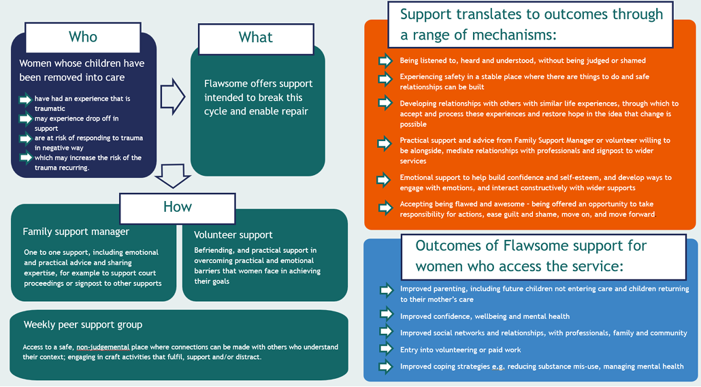
Flawsome is a community-based support programme delivered by Safe Families Home for Good, working primarily with women who have had children removed from their care by the local authority, or are at significant risk of removal, or are seeking reunification with their children. The programme was commissioned in 2020 by the Big Lottery and North East Lincolnshire Council to offer a supportive and relational service to these women with a primary aim of preventing repeat incidents of children entering care. Flawsome combines three core elements: one-to-one support provided by a Family Support Manager, facilitated peer support groups, and community-based voluntary support and companionship.
Our evaluation, carried out between July 2025 and February 2026, looked at routine outcome monitoring data, collected using the ‘Hexagon tool’. The Hexagon tool is an internally developed outcome measure used by Safe Families Home for Good, to assess and track participant progress over time. The tool was used within structured conversations between practitioners and participants, focusing on six key areas: Social Networks, Happiness and Mental Wellbeing, Confidence and Self Esteem, Physical Needs, Family Relationships and Aspirations. We also analysed detailed case narratives relating to 47 women who were referred to Flawsome. To support the findings, we also conducted interviews and focus groups with women, volunteers and professionals involved in the programme.
What we found
We found that overall, women saw improvements in areas such as their aspirations, confidence, wellbeing, social networks, family relationships and physical needs. Most progress was in relation to social networks and wellbeing. We also found a link between programme engagement and the extent of outcomes achieved: women who completed the support demonstrated the most substantial progress, while those who partially engaged showed modest but still positive change. However, it is worth noting that on average, women who completed the support reported fewer difficulties at the outset.
Case notes described women feeling less isolated, more confident and able to use strategies they had developed through the support. This was coupled with positive progress towards achieving their goals and a sense of independence.
For some women, formal services could feel daunting and judgemental. Flawsome helped create a bridge by offering a trusted relationship, practical encouragement and advocacy to support engagement with wider services, including mental health and recovery support.
Children’s Services data also suggested promising outcomes: among women who had had children removed from their care, 65% had no further children removed and 6% had children returned to their care. Although these outcomes cannot be attributed to Flawsome alone, they point to the potential value of relational, preventative support as part of the wider system response.
We also found that support programmes such as Flawsome involve significantly lower costs than adoption and foster care. For instance, our findings suggest a potential one year cost avoidance of £31,747 for each child who may have otherwise entered foster care. This highlights the importance of support that strengthens family wellbeing, helps parents build stability, and supports children to remain safely at home, where appropriate.
What supported change?
Our evaluation highlighted several facilitators of change. The Family Support Manager relationship was often the foundation for wider engagement, helping women feel safe enough to take small steps towards groups, volunteering, community activities or formal services. Peer support reduced isolation and shame by allowing women to connect with others who had lived through similar experiences. Volunteer support offered practical help, companionship and a model of positive social connection.
Together, these forms of support helped women rebuild a sense of identity and possibility. For some, this meant leaving the house more often, attending groups, reconnecting with helpful relationships, accessing mental health or recovery services, starting volunteering or work, or using new strategies to manage emotions and stress.
What can be taken from this?
Overall, while a small sample that reflects the size of the programme, our findings suggest that the Flawsome programme provides a promising example of an impactful service for a group of women who face high-level and complex adversities, and who may otherwise ‘fall through the gaps’. Flawsome also points to the value of working in partnership with community-based and voluntary sector provision that can offer relational continuity, practical help and peer connection. These forms of support may be especially important for people who are not yet ready for, or cannot easily sustain, more formal therapeutic input.
Delivery of the programme aligns well with the government’s early help and prevention priorities, offering a community-based alternative to more intensive statutory involvement where appropriate. Working with parents who are at risk of having children removed, or who have previously experienced removal, enables resources to be concentrated on a small group of parents with complex needs, for whom timely support may prevent further harm and reduce pressure on services. At its centre, Flawsome shows that positive outcomes can be achieved by women who may otherwise not receive support in navigating loss, stigma and complex systems.
You can read the full report on our website here:
Flawsome report
Anoushka Kapoor, Research Officer
Jenna Jacob, Research Lead