Belfast Health and Social Care Trust: using data analysis to benefit care
Belfast Health and Social Care Trust is using CORC data analysis to look more closely at what changes for children and young people after treatment begins, and to explore how outcome measures can support better conversations about the impact of care.
Their work offers a useful example of how members can use their routinely collected outcomes data not just for reporting, but to answer practical service questions and support improvements in care.
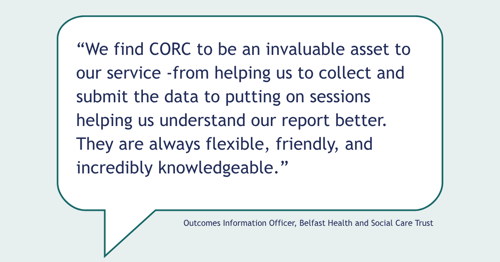
A valued and longstanding member of CORC, Belfast Health and Social Care Trust takes the opportunity each membership year to share its outcomes data with CORC for analysis and reporting. Their report shows how scores change on the outcome measures used by the service. Where measures have been completed more than once during a period of treatment, the report shows the proportion of cases that improve, stay the same or deteriorate. For some measures, it also shows whether those changes are statistically reliable. For a range of measures, Belfast Trust can also compare its results with the rest of the CORC dataset, made up of data submitted to CORC in recent years.
This year, service leads also wanted to explore an additional question: do change scores on the measures used differ according to the number of sessions a child or young person attends? The question followed discussion of the previous year’s CORC data report, which highlighted that service users were supported to complete measures at assessment and then again six months later. However, many service users were waiting for treatment during that six-month period, meaning any change in their scores did not necessarily reflect the impact of the service. To understand this more, Belfast Trust funded additional data analysis to understand whether outcomes were better for people who had attended treatment sessions.
The CORC data report presented analysis that showed the changes in outcomes from two routinely used outcome measures for children and young people who attended 0-5, 6-15 and 16 or more sessions. The findings indicated the strongest outcomes were seen among those who had attended between 6 and 15 sessions, confirming Belfast Trust’s hypothesis.
As a result of this finding, the service is evaluating its approach to data collection and considering whether measures should be completed at assessment and again after a set number of sessions. This development has also helped practitioners see the wider benefits of outcome measurement, by showing how data can inform practical decisions about when and how change is captured.
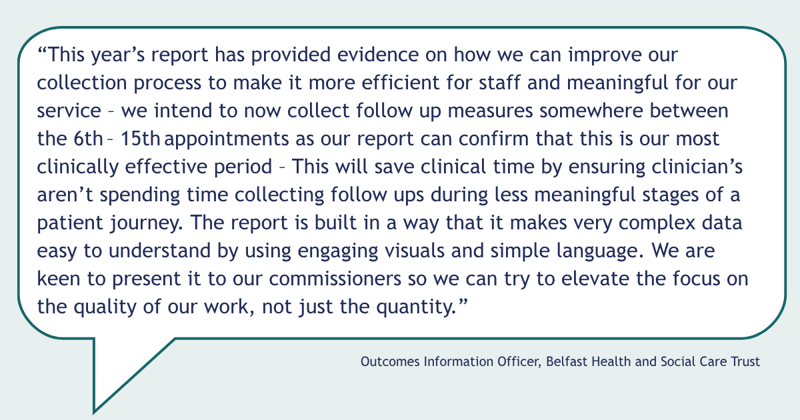
The service is now planning a celebration day to share the analysis findings with wider stakeholders, including partner services, councillors and commissioners. The event will help build a shared focus on indicators of quality and impact, including outcomes data.
Belfast have built a growing appreciation of the flexibility of CORC data analysis to explore different questions and are now considering plans for further data submission.