Supporting young people across services: lessons from the West Midlands Vanguard
We recently completed our evaluation of the West Midlands Vanguard, commissioned by NHS England’s West Midlands Health and Justice commissioning team. In it, we explored programme delivery, the experiences and outcomes of staff, young people and families, and its contribution to wider system change. For us, the findings raised a question that will feel familiar to many: what helps to sustain support when young people’s needs span several services?
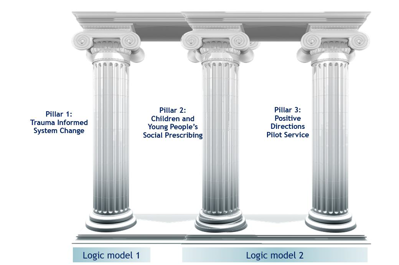
The West Midlands Vanguard supports children and young people with multiple, overlapping needs across Coventry and Warwickshire through NHS England’s Framework for Integrated Care (Community)[1]. Co-produced with young people, its support combines three pillars: Positive Directions, offering direct support to children and young people; Positive Pathways, offering social prescribing; and system trauma-informed practice, using training, shared learning and organisational change to improve how services understand and respond to young people’s needs. Children are referred to the West Midlands Vanguard primarily via social care.
In our evaluation, we explored implementation, impact, and the mechanisms of change. To do that, we conducted interviews, focus groups, and observations of professional activity, and analysed cost, referral and outcomes data. A Young People’s Advisory Group informed our evaluation approach and interpretation of the findings.
Relationships are part of the work, not simply a route into it
Relationships are a cornerstone of trauma-informed care for children, providing the foundation for trust, engagement and responsive support that recognises children's individual needs[2]. What came through repeatedly in our qualitative discussions was the importance of how support was offered, alongside what was offered. Consistent, flexible and non-judgemental practitioner-young person relationships appeared central to engagement, with support shaped around young people’s interests and circumstances rather than a fixed service pathway. This focus on the importance of relationships will feel familiar and is backed by research which suggests that stronger therapeutic relationships are associated with better outcomes in therapy[3].
The practical challenge that comes with this type of work is creating conditions in which those relationships can develop and be sustained. Growing caseloads and time-limited provision could put pressure on the ability to do this effectively. Continuity also matters when support ends: some families felt uncertain about what would happen next, highlighting the importance of early, collaborative transition planning and clear links to ongoing support from other services. Research supports the importance of treating endings as a meaningful part of the therapeutic process and planning them early and collaboratively[4].
Working on shared understanding needs time and space to happen
Our findings from interviews and observations suggested that shared discussions, specialist input and cross-agency collaboration encouraged more trauma-informed and less stigmatising approaches to take place. Reflective spaces helped professionals understand behaviour in the context of trauma and adversity and to coordinate their responses. This suggests that work around a young person, not only direct support, can be an important part of the offer to support young people who have multiple needs. Putting wider systems change into practice is not straightforward, and it was still developing during our evaluation.
For us, this was a reminder that shared understanding in practice needs more than training to be effective. Professionals need protected time for shared formulation, supervision and reflection. Leadership and practical support across agencies are needed to make these activities part of everyday work[5].
Support that connects with what matters to young people
Social prescribing connected young people with activities that mattered to them and appeared to strengthen community connection. Alongside specialist input, advocacy and family support, these opportunities linked support with everyday life rather than focusing on one difficulty in isolation. This brings us back to the importance of focusing on what matters in a young person’s life in addition to their clinical needs and recognising the role of meaningful activities and community connections in supporting wellbeing[6]. Our evaluation also highlighted that social prescribing needs adequate budgets and sustainable community partnerships to be delivered effectively.
What can we say about outcomes?
Young people and families described improvements in general wellbeing, confidence, routines, family communication and participation in education and community activities. Practitioner-rated outcomes also suggested improvements in mental health and wellbeing, education and accommodation status. This provides promising evidence of the programme’s contribution to several areas of young people’s lives.
Gaps in outcome recording limit what we can conclude from these findings. For us, this also raised a familiar question: how can outcome recording remain proportionate while capturing change for individuals, relationships and the wider system? Across several programmes supporting young people with multiple needs, tracking relationship-based support and its wider system impact has proved challenging. Moving forward, this means considering both longer-term outcomes that may be linked to relationship building and changes across the wider system, so that ongoing measurement better reflects the scope of their work.
Reflecting on this learning
For teams reflecting on these findings, a useful starting point is to ask: what helps us sustain trauma-informed support, and what needs to change around us to make it possible? The learning from our evaluation points to practical priorities: protecting time for relationships and shared reflection, planning transitions early, and sustaining community connections. Our report recommendations include adapting delivery to local circumstances while maintaining these foundations, rather than relying on training or individual commitment alone. We hope this learning supports conversations within teams and across services about how to make this way of working sustainable.
If you’d like to hear more, I’ll be sharing findings on prevention work across several of our evaluations, including the West Midlands Vanguard, at the upcoming CORC Forum on 26 November.
[1] Rogers, A., Fuggle, P., Fonagy, P. The Framework for Integrated Care: a catalyst for change to enhance services for children and young people at risk. 2024; Anna Freud, London.
[2] Brown JD, King MA, Wissow LS. The central role of relationships with trauma-informed integrated care for children and youth. Academic Pediatrics. 2017 Sep 1;17(7):S94-101.
[3] Karver MS, De Nadai AS, Monahan M, Shirk SR. Meta-analysis of the prospective relation between alliance and outcome in child and adolescent psychotherapy. Psychotherapy. 2018 Dec;55(4):341.
[4] Vidair HB, Feyijinmi GO, Feindler EL. Termination in cognitive–behavioral therapy with children, adolescents, and parents. Psychotherapy. 2017 Mar;54(1):15.
[5] Galvin E, Morris H, Mousa A, O'Donnell R, Halfpenny N, Skouteris H. Implementation of The Sanctuary Model in residential out-of-home care: Enablers, barriers, successes and challenges. Children and Youth Services Review. 2021 Feb 1;121:105901.
[6] Brettell M, Fenton C, Foster E. Linking leeds: a social prescribing service for children and young people. International Journal of Environmental Research and Public Health. 2022 Jan 27;19(3):1426.